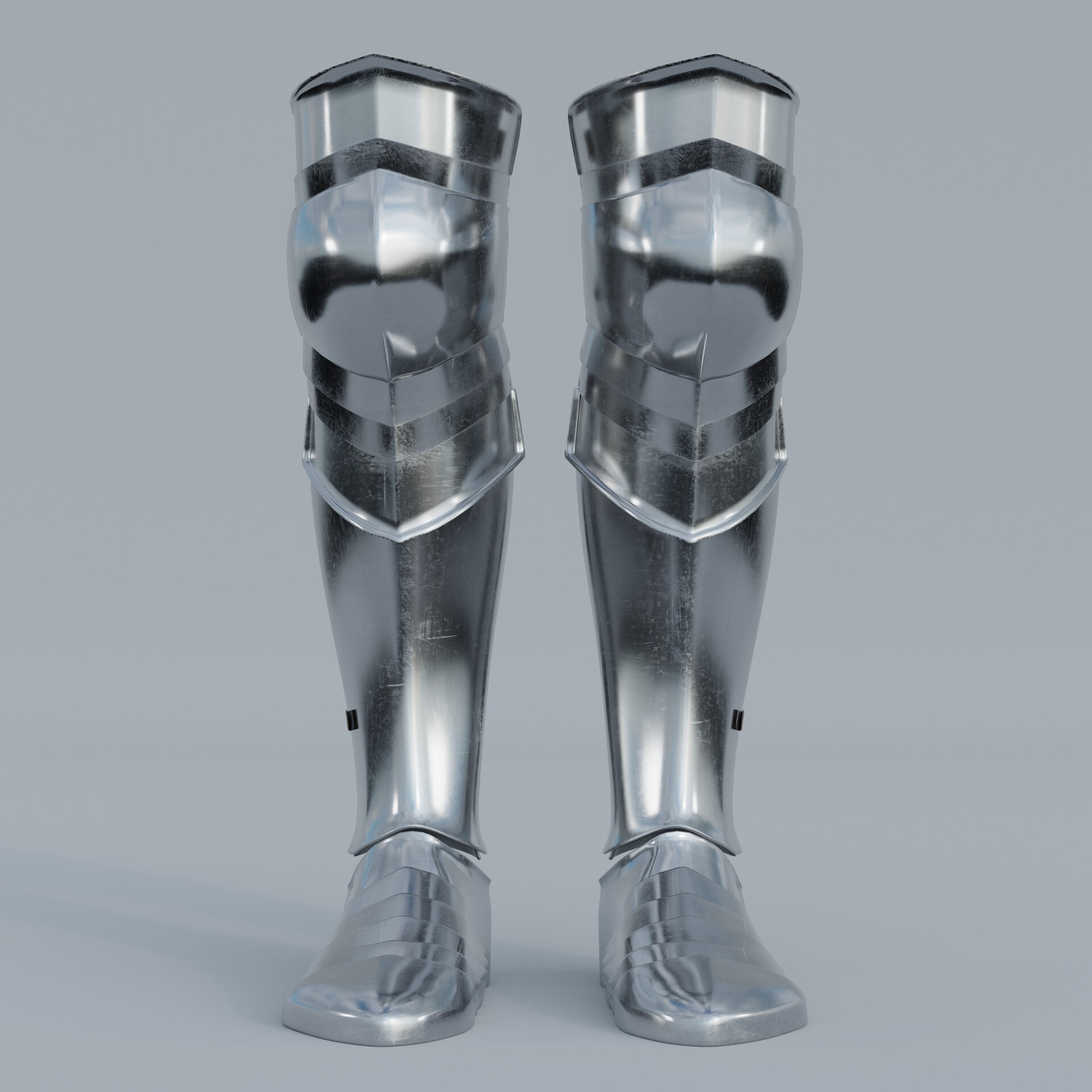
European Medieval Greaves with Sabatons/Solleretes
A greave (from the Old French greve "shin, shin armour") or jambeau is a piece of armour that protects the leg. Greaves were common until around the 9th century AD, when they largely disappeared from use. The first evidence of their reappearance is in the 1230s or 1250s. Illustrations showing “closed greaves”, or greaves that protected the entire leg first appear around 1290 and become popular in the 1320s. Closed or full greaves are made of two plates joined on the outside by hinges and fastening with buckles and straps on the inside. Full greaves were used from the mid- 14th century all the way though the late medieval period.
Sabatons or solleretes, are is part of a knight's body armor that covers the foot. Fourteenth and fifteenth century sabatons typically end in a tapered point well past the actual toes of the wearer's foot, following fashionable shoe shapes of the fourteenth century. Sabatons of the first half of sixteenth century end at the tip of the toe and may be wider than the actual foot. They were the first piece of armour to be put on, and were made of riveted iron plates called lames.
References:
The Armourer and his craft. A. Beresford Ryley
https://www.gutenberg.org/files/60767/60767-h/60767-h.htm#Page_17
The Defensive Armour and The Weapons and Engines of War of Mediæval Times, And of The “Renaissance.” Robert Coltman Clephan
https://www.gutenberg.org/files/59209/59209-h/59209-h.htm#ip_47
Spanish Arms and Armour. Being a Historical and Descriptive Account of the Royal Armoury of Madrid. Albert F. Calvert
https://www.gutenberg.org/files/47878/47878-h/47878-h.htm
https://irongatearmory.com/product/closed-greaves/
https://www.tienda-medieval.com/blog/las-grebas-en-la-edad-media.html
https://dspace.uevora.pt